Tough but Sweet SVG: A Designer's Review
As someone who spends hours digitizing and stitching for clients, I approach every new digital embroidery file with a mix of curiosity and skepticism. We have all been there: you buy a design that looks perfect on the screen, only to find out it turns into a bird's nest of thread once it hits the fabric. That is why I took a close look at the Tough but Sweet SVG Cut File before committing it to a real-world project. This isn't just about whether the lines look clean in a vector program; it is about how this design holds up when you are trying to deliver a high-quality handmade product to a paying customer.
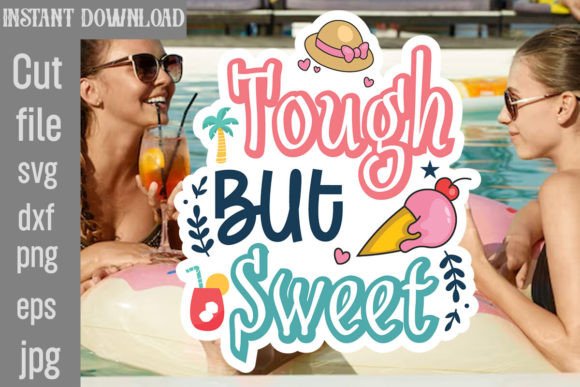
The first thing that strikes me about this asset is its visual personality. The phrase "Tough but Sweet" suggests a duality that is very popular in modern boutique branding. It appeals to parents wanting something edgy yet adorable for their kids, or adults who appreciate a bit of grit mixed with charm. When I opened the files included in the download—specifically the SVG file for Cricut, the DXF file for Silhouette, the EPS vector, and the high-resolution PNG—I was looking for clarity. For an embroidery project, the source graphic needs to have distinct shapes so that the digitizer (or the auto-digitizing software you might be using) can interpret the boundaries correctly. The layout here feels balanced, offering enough negative space to prevent the stitches from merging into a solid blob, which is crucial for maintaining definition.
Putting the Design to the Test: A Real-World Scenario
To truly evaluate this design, I imagined a specific client request. Let's say a local boutique owner wants a run of custom toddler sweatshirts for a spring collection. They need something that stands out on the rack but doesn't look cheap after three washes. This is where the Tough but Sweet SVG Cut File shines as a starting point. Because the theme is versatile, it works perfectly for baby embroidery or sweatshirt embroidery. The "tough" element allows for bold fonts or rugged iconography, while the "sweet" aspect invites softer color palettes or rounded details.
If I were preparing this for production, my first step would be to use the provided PNG file (which comes at 300 DPI with a transparent background) to create a printable mockup. This helps the client visualize the finished product before we even thread the machine. However, moving from a graphic to a machine embroidery design requires careful planning. Since this product is categorized under Crafts and Graphics, it is primarily a cut file or a print-ready image. If you intend to embroider this directly, you must ensure your digitizing software can trace these vectors cleanly. The EPS file is particularly valuable here, as it allows for infinite scaling without losing quality, ensuring that whether you are making a tiny embroidered patch or a large back-panel design for a jacket, the lines remain crisp.
Navigating Fabric Choices and Stitching Challenges
One of the most critical aspects of using a design like this is understanding where it might fail. While the graphic itself is strong, the transition to thread introduces variables. If you are applying this to a tote bag design made of heavy canvas, the stitch density needs to be high enough to cover the weave of the fabric. Conversely, if you are working on a thin, stretchy t-shirt, a dense fill stitch could cause the fabric to pucker, ruining the "sweet" aesthetic with a distorted look.
I always advise fellow Etsy sellers and craft business owners to test the design on scrap fabric first. Pay close attention to small details. Does the design have tiny lettering or intricate corners? These areas are prone to breaking or becoming unreadable if the stitch density is too low or if the hoop size forces the design to be scaled down too much. For curved surfaces like caps or hats, the layout of the "Tough but Sweet" text might need adjustment to follow the curve of the crown properly. A straight line that looks good on a flat pillow cover can look awkward on a structured hat.
Furthermore, consider the fabric texture. On dark fabrics, you will need to check your thread color contrast carefully. A light-colored "sweet" element might get lost against a navy blue hoodie if the satin stitch isn't wide enough or if the underlay isn't sufficient. Using the right stabilizer is non-negotiable here. For knit fabrics like those used in custom apparel, a cut-away stabilizer is often safer than tear-away to prevent the design from shifting over time, especially for items that will see frequent washing like kitchen towels or aprons.
Commercial Viability and Brand Consistency
For small shop product lines, consistency is key. The Tough but Sweet SVG Cut File offers a thematic anchor that can be adapted across various design assets. You could use the SVG for heat transfer vinyl on one line of products and the embroidered version on another, creating a cohesive brand identity. This versatility increases the perceived value of your personalized gift offerings. Customers trust brands that pay attention to detail, and a clean, well-executed embroidery job signals professionalism.
However, a word of caution regarding licensing and file usage: The product description states this is a DIGITAL DOWNLOAD ONLY containing SVG, DXF, EPS, and PNG files. It does not explicitly state that it includes a pre-digitized embroidery file (like PES, DST, or XXX). This is a vital distinction. As a designer, you must confirm whether you are expected to digitize this graphic yourself or if the seller provides separate embroidery formats. If you are not a digitizer, you may need to hire one to convert these vectors into a proper applique design or standard stitch file to ensure optimal stitching clarity. Always review the license terms to confirm if the design is approved for commercial embroidery projects before selling finished items.
Final Thoughts for Makers and Entrepreneurs
In the world of creative entrepreneurs, the difference between a hobbyist item and a boutique-quality product often comes down to the preparation. The Tough but Sweet SVG Cut File provides a solid foundation with its clean vectors and high-resolution raster options. It captures a mood that resonates with current trends, making it a smart choice for holiday embroidery, wedding gifts, or everyday boutique branding.
My recommendation is to treat this graphic as a premium raw material. Respect the design by testing it rigorously on different thread colors and fabric types. Check how the running stitch outlines interact with fill stitch areas in your digitizing software. By taking these practical steps, you ensure that the final result honors the "tough" durability and "sweet" charm the design promises. Whether you are an apparel decorator filling a large order or a maker creating a one-off holiday gift, this design has the potential to elevate your work—if handled with the care and technical insight it deserves.